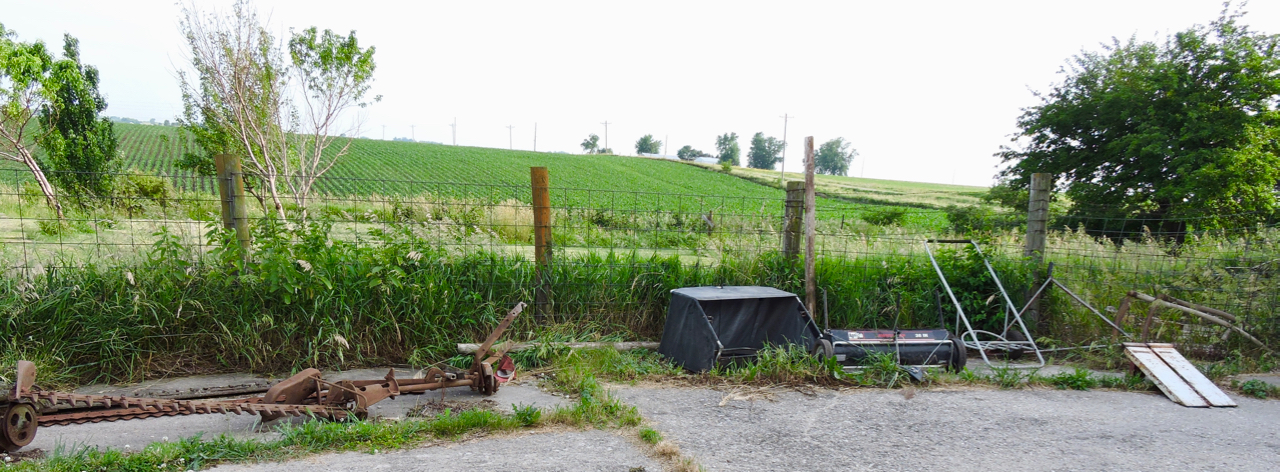
February 4, 2010 – Thingamajig Thursday #194
Here’s this week’s thingamajig Thursday.
Also check out the last thingamajig answer.

As always, put your guess in a comment below.
high hopes gardens is a living experiment. Can a creative, hard-working family make a living working with nature? Join us on the journey from idea to practice as we revive an Iowa Farmstead.

Here’s this week’s thingamajig Thursday.
Also check out the last thingamajig answer.

As always, put your guess in a comment below.
I’ve noticed over the past few months, that the word “activist” has become a new pejorative buzzword. I’ve been trying to figure out the rhetorical appeal of the word. I’ve figured out the typically an “activist” is someone out of step within the current system. There are environmental activists, organic activists, alternative energy activists who seemingly have a common agenda to somehow destroy life as we know it. I couldn’t figure out why these activists are so dangerous to the status quo. For example, even though organic farms are less than 1% of Iowa farmland, non-activists have spent lots of money on TV and radio ads subtly and not-subtly casting aspersions on organic and sustainable farmers. It didn’t make any sense to me why they would devote so many resources to defending the status quo. Then I ran across this paragraph by Maine farmer Eliot Coleman (few conventional Iowa farmers would consider anybody in Maine a “real” farmer) and was struck by the statement from Jefferson.
But there is one other connection between the word “radical” and small farms that I need to mention. The small organic farm greatly discomforts the corporate/industrial mind because the small organic farm is one of the most relentlessly subversive forces on the planet. Over centuries both the communist and the capitalist systems have tried to destroy small farms because small farmers are a threat to the consolidation of absolute power. Thomas Jefferson said he didn’t think we could have democracy unless at least 20% of the population was self-supporting on small farms so they were independent enough to be able to tell an oppressive government to stuff it. It is very difficult to control people who can create products without purchasing inputs from the system, who can market their products directly thus avoiding the involvement of mercenary middlemen, who can butcher animals and preserve foods without reliance on industrial conglomerates, and who can’t be bullied because they can feed their own faces.
On Monday, I gave a presentation about our household’s efforts to reduce energy use and increase dependence on renewable sources. I was followed by a member of a biodiesel co-op, and finally by someone from Alliant Energy. This person applauded the energy conservation efforts, but not-so-subtly, again mentioned the word “Activists” advocating renewable energy when it is perfectly clear to him that alternative energy systems will never replace coal plants and are essentially a waste of money. I guess if you have a hammer (an electric utility) then your job is to generate and sell electricity at the lowest possible cost. If someone comes along with a socket set, you don’t really think the socket set will work for driving nails. For if everyone used a socket with an attachment to twist in screws instead of a hammer to nail things in, your hammers wouldn’t be as valuable.
But this got me thinking about larger questions and confluences in food, energy, and farming. I think it boils down to a difference in values. If an urban Sierra Club chapter fights to save a wetland from “development” or a lake from being polluted by farm chemicals, they are labeled “Activists.” If a group of guys with guns like Ducks Unlimited or Pheasants Forever purchase wetlands/native areas they are not labeled “Activists.” Is the answer as simple as arming Sierra Club members? Is saving something for someone else besides yourself all it takes to be labeled an activist?
I think that small farmers, renewable energy proponents, and anyone else engaged in a pursuit that is counter to the prevailing system need to consider a different tack. Our economic system is supposed to serve us – after all, we invented it. Instead, most of us are slaves to the system, not being served by the system. The reason is simple. The practice of or current economic system does not meet basic human needs. Self-sufficiency, taking care of your family and neighbors is one of the historical human needs. So when I’m told I’ve made a terrible economic decision in installing a renewable energy system, or not farming like my neighbors, I think about this. Economics and profit are the motivating factor for every major corporation. Humans, are not like that, however. We don’t make decisions based on solely economic reasons (and if we do, we end up being unhappy and unfulfilled).
What’s the financial return on having children? What’s the financial return on taking care of aging parents? What’s the return on buying a $10,000 fishing boat and gear? What’s the return on a BMW S series? What’s the financial return on farming to conserve soil if you are only alive for 80 years and the soil has 100 years of abusive farming practices left before the other half is gone? There’s something larger than economic return going on here. For too long, organic, sustainable, and energy “activists” have been using the traps of the current economic system to justify their actions. My suggestion – stop explaining the economic returns of your sustainable methods in financial terms. Talk about how “It’s just the right thing to do.” You’ll be assaulted with terms like “niche” “hobby,” or perhaps if you are really on the edge “crackpot.” Talk about how it’s the right thing to do. It feeds my spirit. It connects me to generations in the future. Talk about the satisfaction of pulling a crop or kilowatt out of your place like hunters talk about their exploits outfoxing wild animals.
Our story is much more interesting than a corporate anything. Commodity agriculture doesn’t have a story. Who wants to visit a modern hog farm? Who wants to work in a modern meatpacking plant? Heck, who wants to visit a corn/soybean farm except maybe for a couple weeks in the spring or fall? Contrast that to the small farmer who has a diversity of crops and animals, an ever-evolving network of plants and animals, with a fast two-step throughout the season. Tell your story – it’s much deeper and more connected to the human spirit than any slick corporate ad. We need you, we’ve fallen below Jefferson’s 20% threshold.
Ever wonder what a half a beef looks like before it goes into the freezer?

Here is one – we had it processed with an emphasis on the things we eat most often – hamburger and steak. The basket on the right is full of steaks. The next one is roasts, the next one over is ribs/soup bones, and of course, the last two hamburger. Here’s the breakdown from this half.
71 lbs steaks
54 lbs roasts/ribs/soup bones
148 lbs burger
The total cost for this ends up being about $3.30/lb – that’s everything from hamburger that probably average $2 lb at the store to rib eye and t-bones at $7-9/lb. Best of all, this beeve was visible on a local pasture on our way to town. It was grass-raised and finished with some corn, so it wasn’t wallowing in a feedlot in it’s own doo-doo during its lifetime.
The subtle colors of morning on the snow mean it is a sunny day.

In the summertime it’s harder to get up with the sun, that’s not a problem this time of year. But tomorrow marks the midday-point between the first day of winter and first day of spring.

I had a chance to attend a meeting (actually I presented about wind energy) near Cedar Rapids. I arrived about a half-hour early and was curious about the recovery after the 500 year flood in 2008. I was struck at the lack of progress in recovery – still blocks of abandoned homes.

You can still see the water lines on the door in the first house.

The next house down the block. The neighborhoods were eerily quiet. No sidewalks shoveled, no cars parked in the street – quiet. I thought of all the effort that people had put into the houses in the 10 square miles that flooded – all in a zone that was never expected to flood. I thought about Katrina and the differences – although the loss of habitation in the neighborhoods is similar, residents of Cedar Rapids did not live with the fact that their homes were below sea level. I can imagine the critters and the like that have moved into these houses with broken windows, and holes in the walls.
The video above is from a web site, the Cedar Rapids Flood Story that tells of the progress and frustrations of falling out of the national news cycle.
The city is stuck with a 5.5 billion dollar repair bill, and has received about 0.3 billion in aid. All the politician’s speeches the days after the flood, were just that – photo ops. The city now faces an unprecedented loss of tax revenue (75% of downtown businesses remain closed) as a result of homes and businesses off the tax rolls, along with a recession, and an unprecedented repair bill. People of Iowa do not need to to travel to other countries or New Orleans for mission trips as long as Cedar Rapids remains is disarray.
I’m not shy about stealing great ideas from others, so if you are looking for a cheap and easy row cover to protect your insect-prone crops like squash and cabbage, check out Herrick Kimball.
The Whizbang Row Cover System looks like a great way to protect your crops at a reasonable price.

Herrick is a man after my own heart, with his ingenious, practical, and cheap ideas and plans. Just to whet your appetite, the photo above copied from his web site shows his homemade clips using old bicycle tubes and scrap wood.
I went out on a windy day to see if I could capture the sound the Skystream makes with my video camera. This is a short video of a Skystream 2.4 kw wind turbine on a 70 foot tower on a windy day. I mainly posted it to show how it sounds. You can compare it to a row of pine trees on the same property the same day. You might have to turn the sound up loud to hear it.
Since standard video cameras do not capture enough frames per second (you would need a special camera to capture the turbine spinning at 320 RPMs) the motion of the blades is not as you’d see with the blur of the naked eye.
For comparison, here’s the row of pine trees the same day.
Here’s this week’s thingamajig Thursday. This is something found in the kitchen, and not for cleaning?
Also check out the last thingamajig answer.

As always, put your guess in a comment below.
We’re starting a new venture – distributing old-style glass coke bottles in these refurbished coolers at convenience stores.

Here’s a bunch of them in the barn. OK, the joke’s over – we are NOT going into beverage distribution, but instead our barn is hosting a staging area for distribution to area farms. These were all give-aways at a distributorship in NE Iowa and are all reserved for small farms for temporary storage of farm products such as vegetables, eggs, etc.
The wind stopped blowing this evening. As usual, the ground was blown clear, or drifted.

We were lucky the chicken coop wasn’t drifted shut, but instead left this sculpted pathway to the coop.

Sundogs this morning towards the morning sun.

Finally, this 25 car and snowplow pileup near Mason City shows what can happen when you drive too fast in a white-out!
The weather people missed out on predicting this storm. We went from winter weather advisory to Blizzard warning in a flash.
I’ll only bother you with four seconds of the view while I was waiting for the early out bus near the closest blacktop road.

We’ve learned it’s just best to take the lead of the animals and hunker down until it passes, like the animals in the barn.
I had to laugh at the poor sap they interviewed on TV who said he shoveled his sidewalk 12 times today – after each shovel it filled in with snow in just 10 minutes. Evidently it took him 12 times to realize it was pointless and it might be better to shovel it just once after the wind stops blowing!
I-35 is closed from Ames to Clear Lake and I-80 is shut from Newton to Grinnell, so we are pretty much getting hammered.
After the recent ice storm, the subsequent weather was a night of rain at 33 degrees with wind. This brought with it a slooooow removal of the ice from the trees over a period of, oh say, over one night. All night the house was pelted with chunks of ice that sounded like golf balls being thrown at the house, about every 15-45 seconds like clockwork. It was amazing in a disgusting kind of way that it could go on for so long and not just get over with. By about 8 am all the ice was finally gone.
Now that we’ve grown our Christmas tree, dug it out of a snowbank, dragged it into the house for the holidays and decorated it, it’s time for the 2nd to last use of the Christmas tree.

Here it is after the animals had a chance to browse the branches and even chew the bark off the tree! The last step will be for the tree to be dragged to the site of next year’s burn pile to be the base for next December’s bonfire. Certainly the high hopes version of the giving tree!
Two days after the ice storm, the ice still hangs on.

The trees are ponderous with ice. This is a spruce tree encased in ice.

Here’s a side view that shows the oh-so-gradual melting of the ice, but not quickly enough for my taste. Tonight and tomorrow we are supposed to warm above freezing and get heavy rain and high winds – we hope that the warmth precedes the wind, otherwise the powerlines will be a mess.